Impact
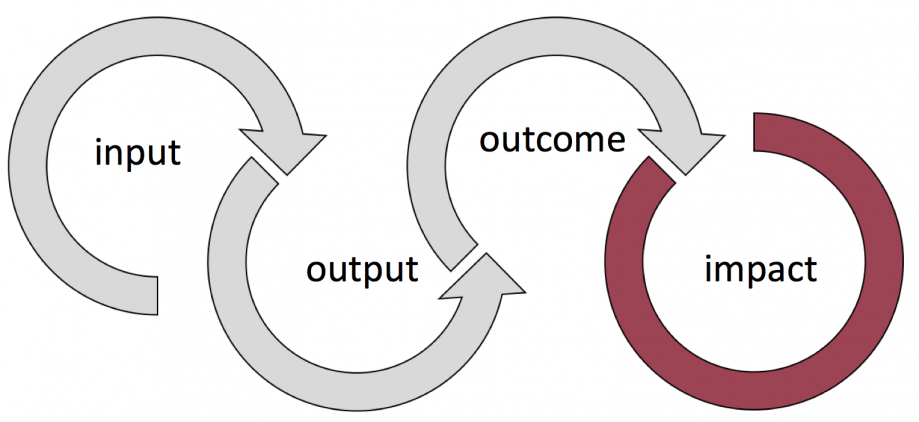
In contrast to outcome, which measures the direct achievements of a Service Learning project, impact comprises the long-term effects the project aims to achieve.
Academic learning
In the university context, Service Learning projects are particularly suited to promote competence-based learning. Competences have been defined as “the cognitive abilities and skills available to or learnable by individuals to solve specific problems associated with motivational, volitional and social dispositions for using these skills and abilities in variable situations” (Weinert 2001). Depending on the project design, lecturers can define learning objectives for their modules in the following areas:
- Knowledge comprises the ability to retrieve acquired content (e.g. terms, facts, theories, rules, etc.) with the help of certain cues.
- Comprehension describes the ability to understand (complex) relationships and transfer such relationships to analogue situations.
- Application includes the ability to apply theories, rules, terms, etc. in concrete situations. The respective situations are previously unknown.
- Analysis refers to the ability to break down models, processes, etc. into their individual components. This includes the discovery of complex sets of facts, structural principles or internal structures as well as the discernment of complex relationships.
- Synthesis relates to the ability to put together parts or elements to form or construct a well-organised whole with a new structure.
- Evaluation is the ability to assess, appraise and review facts on the basis of (empirical or theoretical) criteria.
Relevant details on this subject (in German) have been published by the University of Ulm. Go to flyer
Community engagement
Civic involvement should trigger mind shifts and transformation processes – the more systematic and sustainable they are, the more motivating and effective Service Learning becomes for all stakeholders. In this context, the impact is a primary objective that may at first appear abstract and therefore requires diligent operationalisation.
The three-pillar model, built on ecology, social matters, and economy, promotes an operational and simultaneously holistic perception of the sustainability of the Service Learning project:
- How do the project activities affect resource efficiency in organisations, environmental awareness among the public or sustainable consumption skills?
- Which social and cultural issues, such as poverty, education, health or civic participation, are affected?
- Does the project lead to economic efficiency, remove material wants or secure financing for community interests?
Projects are not always suitable to address all three pillars and the pillars may affect different target groups to a different extent. Lecturers can either introduce these questions according to a plan or bring them up jointly with all participants during implementation.